
005: Forgetting words mid-sentence, walking into rooms with no idea why: what's actually happening to your brain

You are in a meeting. You are prepared. You know what you want to say. And then the word — a word you have used a thousand times — simply isn't there. You pause. You work around it. The meeting moves on. But something in you notices what just happened. And it bothers you in a way that's hard to explain.
Or you walk into a room and have no idea why you went in there. Or you read the same paragraph three times and nothing sticks. Or you reach for someone's name — someone you know well — and it just won't come.
For women in their 40s and 50s navigating perimenopause and the years that follow, this is one of the most unsettling experiences of this season. Especially for women who have always relied on their minds. Women who have built careers, raised families, and handled enormous responsibility — all on the strength of a sharp, reliable brain.
By the end of this episode, you'll understand what is actually happening — and one thing you can start doing today that directly supports your brain during this season.
What is happening in your brain
Most people think of estrogen as a reproductive hormone. But estrogen is also deeply involved in how your brain works.
Estrogen helps your brain make acetylcholine — the chemical most responsible for memory and focus. It protects brain cells from damage. It keeps blood flowing to the brain. It helps regulate mood. And it affects how your brain gets energy from food.
When estrogen starts to shift and fluctuate during this season of life, all of these things are affected. Not all at once. Not dramatically. But enough that a woman who knows her own mind starts to notice.
The word that won't come? That's acetylcholine. The inability to focus? That's connected to how the brain is getting — or not getting — the energy it needs. The fog that seems to sit over everything? That's the result of several systems all running a little below where they used to be — at the same time.
Researchers at Columbia University found that the brain goes through measurable changes during this hormonal season. Changes in how it's connected. Changes in how it uses energy. This is not in your head. It is happening in your head — but it is biological, not psychological. And it is happening to women who are completely sharp and capable in every other way.
The food connection
Your brain is made mostly of fat — about 60%. And it needs specific nutrients from food to work well — nutrients that are found most reliably in animal foods.
One of the most important is choline. Choline is what your brain uses to make acetylcholine — the memory chemical. Most women don't get nearly enough of it. Another is B12. Without enough B12, the protective coating around your nerve fibers starts to break down — and the symptoms look almost identical to cognitive aging. Vitamin A supports brain health. Vitamin D helps the brain stay flexible and adaptable.
Many health-conscious women are eating a diet that is low in these nutrients — especially those who have been told to avoid animal foods and fat. And that leaves the brain short on exactly what it needs, at exactly the time it needs it most.
How the brain is affected during this season also connects to gut health, sleep quality, and other hormonal changes. Some women notice a significant difference when they address the nutritional piece. Others need more layers of support.
What is clear is this: the brain fog has a cause. And part of that cause is nutritional.
From my own experience
I know this firsthand. When I changed how I was eating — after three years of plant-based eating that had left my body seriously depleted — my best friend noticed the difference before I did. He said I was moving faster. More present. More like myself. And he was right. I had been moving slowly, thinking slowly, living inside a fog so gradual I had stopped noticing it. I hadn't recognized it as fog until it lifted. That's how these changes work. They arrive so gradually that you adapt to them. And then when they lift, the difference is impossible to miss.
Your takeaway from today
The most powerful thing you can do for your brain right now is make sure it has the nutrients it needs to function well during this season. And the single most important nutrient to start with is choline — the building block your brain uses to make the memory chemical acetylcholine.
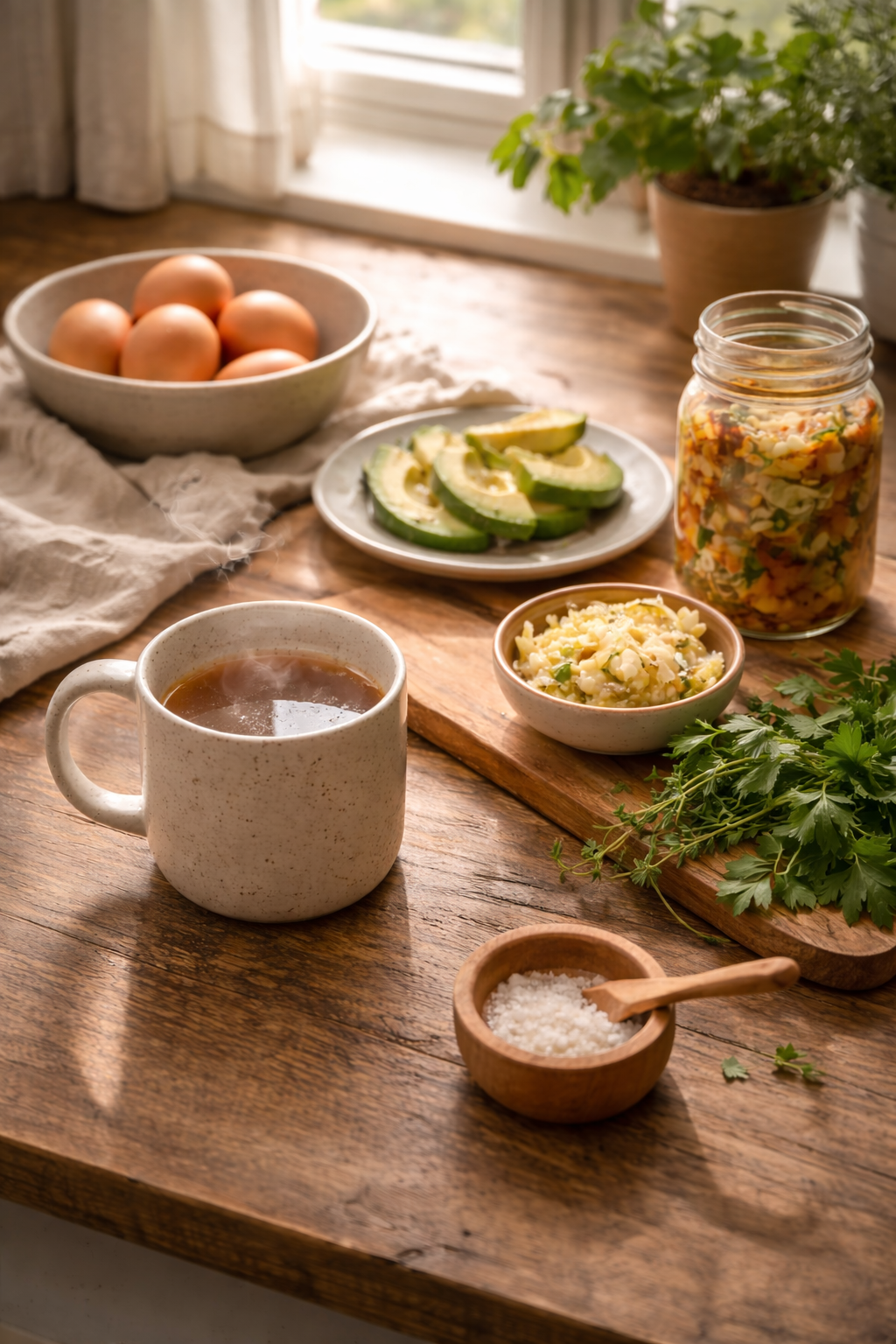
The richest source of choline available is eggs. Start there.
The brain fog you have been living with is not a permanent feature of this season. It is often a signal. And nutrition is one of the most direct ways to answer it.
If you want a clear, structured way to build these nutrients into your daily eating — with the education, recipes, shopping lists, and menu plan to make it straightforward — that is exactly what Nourish is built for. It's my 21-day ancestral nutrition immersion, and it includes a bonus masterclass called Nourishing Your Hormones, built specifically for women at this stage of life. You'll find it at nourishwithkatrina.com/nourish.
To your vibrant health and freedom,
Katrina
When you're ready to begin:
Nourish is my 21-day ancestral nutrition immersion, designed specifically for women in perimenopause and menopause. Over 21 days, you’ll learn the nutritional foundations that support hormone balance, gut health, metabolic function, and bone density — all through the lens of ancestral food wisdom and the science behind it.
It includes the bonus masterclass Nourish Your Hormones, a 7-part series on exactly what is happening in your body right now and what food can do about it.
Not ready yet?
Start here: Download my free guide — Why Women Over 40 Need 100g of Protein Daily — and I’ll walk you through the most important first shift in an ancestral nutrition approach. No tracking, no rules. Just real food, and the reason it matters now.
Nourish with Katrina
🎧 Podcast
Conversations on gut health, hormones, ancestral nutrition, and vibrant, holistic health for women 40+.
Available on:
Apple Podcasts | Spotify | YouTube
Nourish
The 21-Day Ancestral Nutrition Immersion
A simple path to more energy, calmer digestion, and balanced moods during the peri/menopause transition.
Practical meals • Daily guidance • Real nourishment
