
The Gut-Hormone Connection: Why Your Microbiome Controls Your Estrogen Levels

Your Gut and Your Hormones: The Connection Nobody Talks About
Your gut manages your estrogen. Most women have never been told this.
And once you understand how that works, a lot of things that felt random and unrelated — the bloating, the midsection weight, the mood swings, the brain fog — start to make sense as one picture.
"I've started having digestive issues I never had before. And somehow it all started around the same time as everything else — the hot flashes, the mood changes, the weight gain. Is that a coincidence?"
It's not a coincidence. It's one of the most important connections in the biology of perimenopause, and it rarely comes up in the standard conversation around hormone health.
What the Estrobolome Actually Is
Inside your gut lives a specific community of bacteria called the estrobolome. These bacteria produce an enzyme called beta-glucuronidase, and that enzyme does something that directly shapes your hormonal health: it reactivates estrogen that your liver has already processed for elimination.
Here's how it works. Your liver metabolizes estrogen, packages it up, and sends it to the gut to be cleared from the body. In a healthy gut with a well-functioning estrobolome, this process runs smoothly — estrogen is metabolized, bound up, and cleared efficiently.
When the estrobolome is disrupted — when the microbial community is out of balance — beta-glucuronidase activity can become either excessive or insufficient. If it's excessive, estrogen that was meant to be eliminated gets reabsorbed back into circulation. Estrogen that should have left your body returns to it instead. This can contribute to what's often called estrogen dominance — a relative excess of estrogen compared to progesterone, which drives a specific set of symptoms many women in early perimenopause recognize: midsection weight, mood instability, bloating, heavy periods, breast tenderness.
If beta-glucuronidase activity is insufficient, estrogen metabolism becomes sluggish, and the result can be estrogen deficiency at the cellular level — even when blood levels look normal on standard testing. This is one of the reasons two women with identical estrogen levels on a blood test can feel completely different. The estrobolome is part of the answer the blood test doesn't show.
What Disrupts the Estrobolome
The estrobolome is shaped by everything you've eaten, taken, and been exposed to over the course of your life. And by the time most of us reach perimenopause, we're carrying microbial disruption we've never specifically addressed.
Antibiotic use is one of the most significant disruptors of gut microbial diversity. A single course of antibiotics can wipe out strains of bacteria that took years to establish, and without deliberate replenishment through food and time, many of those strains don't fully recover. Most of us have had multiple courses over our lifetimes, often with no guidance on restoration afterward.
A diet low in fermented foods and real fiber deprives the estrobolome of what it needs to thrive. Traditional cultures ate fermented foods regularly. Most modern diets contain very little of these.
Chronic stress directly impacts gut motility, gut lining integrity, and microbial balance. Elevated cortisol — which many women in perimenopause are running on constantly — changes the environment in which gut bacteria live and reproduce.
And then there's the hormonal transition itself. Estrogen and progesterone directly influence gut microbial balance. As these hormones shift and decline, the microbiome responds. The disruption goes both ways: hormonal changes affect the gut, and a disrupted gut worsens hormonal imbalance. You can't fully resolve one without addressing the other.
The Symptoms That Connect
Once you understand the estrobolome, a pattern of symptoms that seemed unrelated starts to make sense together.
Midsection weight that arrived without a change in how you eat can be connected to estrobolome disruption and the resulting shift in estrogen metabolism. Persistent bloating — the kind that no elimination diet has resolved — may be pointing to gut dysbiosis rather than a food sensitivity. Mood instability, anxiety, and the low-grade emotional flatness many women in perimenopause describe are connected to both gut health — your gut produces around 90% of your serotonin — and estrogen metabolism. Skin changes, brain fog, and inflammation can all have roots in a gut that isn't functioning well.
I know what this feels like from the inside. For years I had bloating I considered completely normal — daily, predictable, connected in my mind to nothing in particular. Looking back, it was likely tied to my vegan diet. It may have had a hormonal component too. I'll never know for certain. What I do know is that it wasn't just how my body worked. There was more going on than I realized at the time — possibly a gut that needed more support than I was giving it.
What Feeds a Healthy Estrobolome
Here's the piece that genuinely changed things for me: the estrobolome responds to food. Not supplements. Not protocols. Food — the foods that traditional cultures ate as a matter of course, the foods that have been feeding healthy human microbiomes for thousands of years.
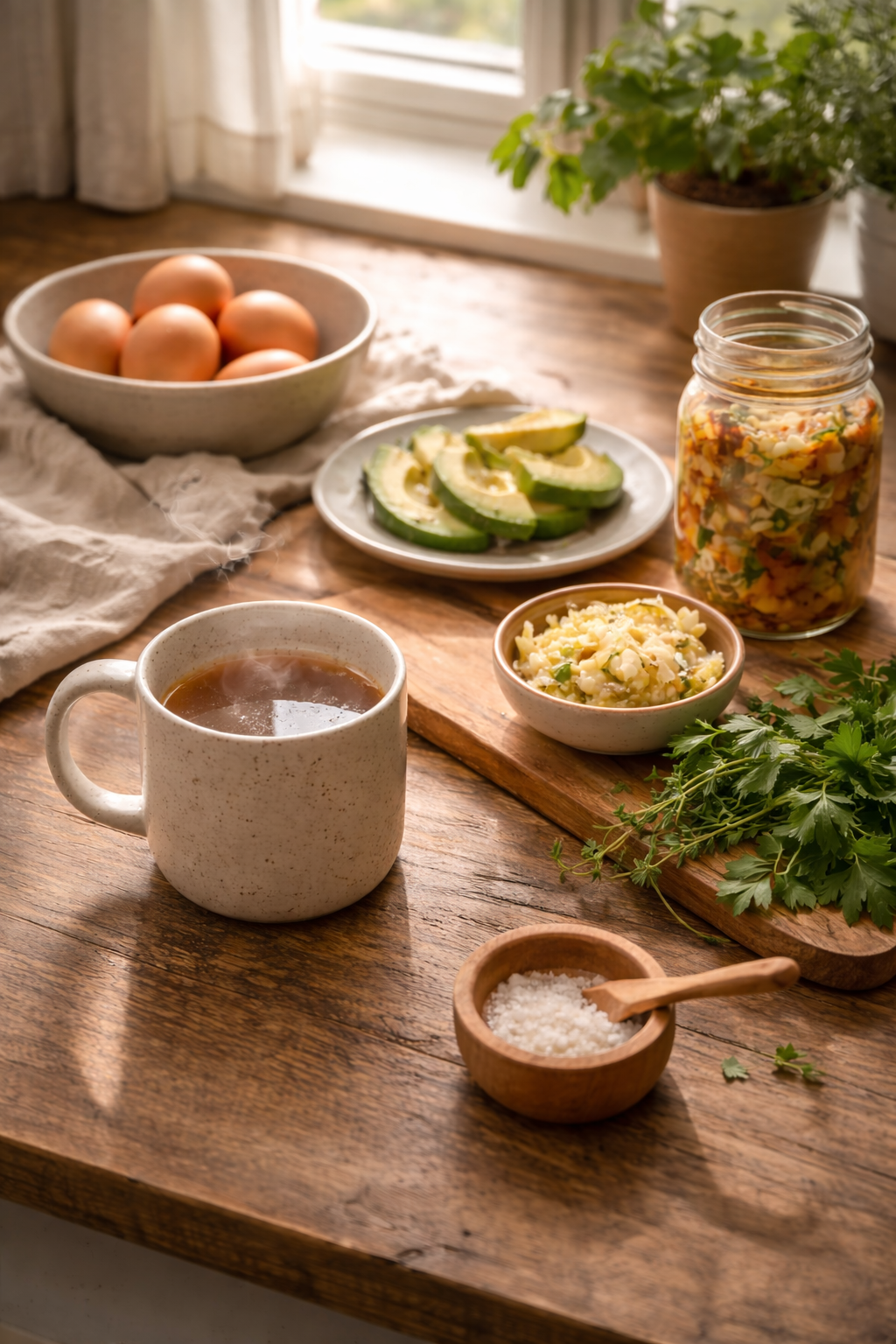
Fermented foods are the most direct way to nourish microbial diversity. In traditional diets, these weren't specialty health foods — they were simply food, present at most meals.
Bone broth supports gut lining integrity. The gelatin and collagen in a properly made bone broth help maintain the tight junctions of the intestinal wall, reducing the inflammatory permeability that compounds both gut disruption and hormonal imbalance.
Cruciferous vegetables provide the fermentable fibers that beneficial gut bacteria need, and they contain compounds that directly support estrogen detoxification in the liver. They are targeted hormone support.
Animal protein provides the amino acids foundational to gut lining repair — in forms that are difficult to replicate from plant sources alone.
Supporting your gut is not a secondary concern during this transition. It is the foundation on which every other hormonal shift either improves or stays stuck.
Where to Start
If you want to understand exactly how to bring these foods in — in a way that's practical and built around where you are right now — that's exactly what we work through inside Nourish. A 21-day ancestral nutrition immersion with a meal plan, recipes, shopping lists, and 21 days of bite-sized education you can put into action immediately. No guesswork. Just real food and real results.
Questions I Hear Often
Should I take a probiotic supplement?
Probiotic supplements can be a useful addition — particularly after antibiotic use or during periods of acute gut disruption. But they're not a substitute for fermented food, and many commercial probiotic strains don't colonize the gut long-term. Food is the foundation. Supplements can support, but they can't replace.
How long before I notice a difference?
The gut microbiome responds to dietary change more quickly than most people expect. Most women notice differences in digestion, bloating, and energy within four to six weeks. Hormonal shifts tend to follow over two to four months of sustained practice. It's a foundation that, once built, holds.
I had a hysterectomy. Does any of this apply to me?
Yes. Even after surgical menopause or hysterectomy, the body continues to produce estrogen through the adrenal glands and fat tissue — and that estrogen is still processed through the liver-gut pathway. The estrobolome remains directly relevant to your hormonal health regardless of surgical history.
A Note Before You Go
The gut-hormone connection wasn't something I understood for a long time. For years I didn't recognize what was happening in my own body. Once I did, and once I started eating in a way that actually supported my gut, things shifted in a way that nothing else had managed to do.
That's what I want for you too.
To your vibrant health and freedom,
Katrina
When you're ready to begin:
Nourish is my 21-day ancestral nutrition immersion, designed specifically for women in perimenopause and menopause. Over 21 days, you’ll learn the nutritional foundations that support hormone balance, gut health, metabolic function, and bone density — all through the lens of ancestral food wisdom and the science behind it.
It includes the bonus masterclass Nourish Your Hormones, a 7-part series on exactly what is happening in your body right now and what food can do about it.
Not ready yet?
Start here: Download my free guide — Why Women Over 40 Need 100g of Protein Daily — and I’ll walk you through the most important first shift in an ancestral nutrition approach. No tracking, no rules. Just real food, and the reason it matters now.
Nourish with Katrina
🎧 Podcast
Conversations on gut health, hormones, ancestral nutrition, and vibrant, holistic health for women 40+.
Available on:
Apple Podcasts | Spotify | YouTube
Nourish
The 21-Day Ancestral Nutrition Immersion
A simple path to more energy, calmer digestion, and balanced moods during the peri/menopause transition.
Practical meals • Daily guidance • Real nourishment
