
What Women Ate For Generations To Protect Hormones: An Ancestral Approach to Menopause

What Women Ate For Generations To Support Hormones: An Ancestral Approach to Menopause
There's a question I keep coming back to when I think about women's health in midlife. It's not a medical question — it's more of a "wait, why is this happening now?" kind of question.
If the symptoms of perimenopause are just part of life — the weight gain, the hot flashes, the insomnia, the mood swings, the brain fog — then women have been dealing with all of this throughout human history.
But when you look at what women in other parts of the world actually experience, and what women a few generations back went through, the picture looks very different.
The level of disruption so many women experience today seems to be, at least in part, something new. Something has shifted. And I genuinely believe that a big part of what shifted is what we eat.
"My grandmother never complained about menopause. She just... went through it. I don't understand why it's so much harder for us."
I hear this often. And while I'm careful not to paint the past as some kind of golden age, the difference between what they ate and what we eat is real, significant, and worth looking at honestly.
The Book That Changed Everything I Thought I Knew
I came to ancestral nutrition through a door I never expected to walk through. For years, I was vegan — not out of deep personal belief, but something that happened gradually while I was living in Mexico, surrounded by incredible tropical fruit and following plant-based teachers I really respected. I genuinely thought I was eating one of the healthiest diets out there.
Then a dear friend's husband developed a serious neurological condition. Doctors prescribed anti-anxiety medications. I had a feeling it was something else. I started digging. I realized he had nearly every symptom of severe B12 deficiency. He and my friend had been vegan for years and had never once been told to supplement. They went back to their home country, saw specialists, and after months of nutritional treatment, his symptoms reversed. He's healthy today.
That experience made me look at my own diet with fresh eyes for the first time. And right around the same time, I finally picked up a book I'd bought three years earlier and never opened: Nutrition and Physical Degeneration by Weston A. Price. What I found inside was unlike anything I'd come across in years of studying health.
Price was a dentist who got concerned about the rise in tooth decay and bone problems he was seeing in his patients. So he traveled the world studying communities that had no access to modern medicine or dentistry — people eating entirely traditional foods, the way their ancestors had — and compared their health to those eating modern processed diets.
What he found was remarkable. Different parts of the world, different cultures, completely different foods. But one thing showed up consistently: healthy traditional cultures prized animal foods and went to great lengths to get them. Organ meats. Animal fats. Fermented dairy. Bone broth. Fish roe. The whole animal. And in culture after culture that traded those foods for modern processed ones, the health of the community collapsed within a single generation.
I changed my diet overnight. Vegan to fully animal-based — eggs, meat, butter, bone broth, liver. The shift in my body was not subtle. Muscle came back. Brain fog lifted. The deep afternoon exhaustion stopped. My best friend noticed within weeks: you're moving faster.
What Traditional Women Actually Ate
Across the cultures Price studied — and in the broader record of traditional food around the world — certain foods show up again and again, especially for women during big hormonal transitions. These foods weren't eaten casually. They were specifically sought out. In many cultures, they were set aside for the most vulnerable members of the community: pregnant women, nursing mothers, growing children, and older women moving through midlife.
Animal fat was valued. In many traditional cultures, fat was considered one of the most valuable parts of food. These aren't dangerous indulgences — they are the raw material from which hormones are made. The major hormones in your body — estrogen, progesterone, cortisol, DHEA, testosterone — are built from cholesterol. Women a few generations back cooked in traditional fats because the body thrives on them.
Organ meats were prized. Liver, kidney, heart, tongue, bone marrow — these were considered the most nutritious parts of the animal, the pieces saved for the people who needed them most. The nutrients found in organ meats — in their most bioavailable forms — are found almost exclusively in animal foods.
Fermented foods were daily life. Most traditional food cultures had some form of fermented food at the center of everyday eating. These weren't specialty health foods — they were meals. Because traditional cultures understood something we've largely forgotten: a healthy gut is the foundation of a healthy body.
Bone broth was poverty cuisine — what resourceful people made when they used the whole animal and wasted nothing. Rich in minerals, easy on the gut, and deeply nourishing — full of the nutrients that support bone density, gut health, and joints. The exact things that tend to be low in women going through perimenopause.
Why These Specific Vitamins Matter So Much Right Now
Research consistently shows that three fat-soluble vitamins — A, D, and K2 — are found in abundance in traditional diets and are often missing in modern ones.
Vitamin A in its true form — retinol, found in animal foods — is essential for your hormones to work properly, for immune health, thyroid health, and for the health of reproductive tissues. The beta-carotene in plants is not the same thing. Your body has to convert it to retinol, and for many people, that conversion is limited.
Vitamin D works more like a hormone than a vitamin. It's essential for bone density, immune function, mood, and actually absorbing calcium. Women in perimenopause tend to be among the most commonly deficient, and being low in vitamin D is tied to more severe symptoms.
Vitamin K2 tells calcium where to go — to your bones, not your arteries or soft tissue. Without enough K2, calcium supplements can actually calcify arteries instead of strengthening bones. This might be part of why calcium alone hasn't been the bone-saving solution we were told it would be.
Our ancestors weren't just lucky. They were eating the foods the human body was built for. We walked away from those foods in a single generation and called it progress.
Where to Start
If you're curious about what it looks like to actually bring these foods back in — with a meal plan, recipes, shopping lists, and 21 days of bite-sized education you can put into action immediately — that's exactly what Nourish is. No guesswork. Just real food and real results.
Join Nourish →
Questions I Hear Often
I was raised to avoid saturated fat. How do I know this is safe?
The research that led to the low-fat dietary guidelines back in the 70s and 80s has been seriously questioned over the past two decades. Large studies haven't been able to confirm that saturated fat causes heart disease. What those decades of low-fat eating did produce was a big drop in fat-soluble vitamins, a rise in processed carbs as replacements, and — honestly — a worsening of many of the health problems those guidelines were supposed to prevent. I'm not making a political argument. I'm just following where the evidence has gone, and it's shifted quite a bit.
What about plant-based women? Can they still support their hormones?
I speak from my own experience here. A plant-based diet can be made more nutrient-dense than most plant-based diets are. But the specific nutrients that matter most for hormonal health in perimenopause — vitamin A in its usable form, B12, heme iron, preformed DHA, K2, and enough leucine — are either missing or much harder to absorb from plant sources. I'm not here to tell anyone how to eat. But I'm honest about what I see in both the research and in my own body. The nutrients that matter most at this stage of life are found most reliably in animal foods.
Do I have to do this perfectly?
Not at all. This isn't a rulebook. It's a way of thinking about food that's rooted in how humans have eaten for most of our existence. Start where you are. Add before you subtract. Let the food do the work.
A Note Before You Go
I spent years eating in a way I truly believed was the best thing I could do for my body — while quietly building up the deficiencies that were behind my symptoms. The gum recession. The brain fog. The afternoon crashes. The muscle that slowly disappeared. None of it had to go that way — and I know that now, which is why I teach what I teach.
Your great-grandmother's food wasn't behind the times. It was deeply wise. And the years ahead can be your strongest yet, if you give your body what it knows how to use.
To your vibrant health and freedom,
Katrina
When you're ready to begin:
Nourish is my 21-day ancestral nutrition immersion, designed specifically for women in perimenopause and menopause. Over 21 days, you’ll learn the nutritional foundations that support hormone balance, gut health, metabolic function, and bone density — all through the lens of ancestral food wisdom and the science behind it.
It includes the bonus masterclass Nourish Your Hormones, a 7-part series on exactly what is happening in your body right now and what food can do about it.
Not ready yet?
Start here: Download my free guide — Why Women Over 40 Need 100g of Protein Daily — and I’ll walk you through the most important first shift in an ancestral nutrition approach. No tracking, no rules. Just real food, and the reason it matters now.
Nourish with Katrina
🎧 Podcast
Conversations on gut health, hormones, ancestral nutrition, and vibrant, holistic health for women 40+.
Available on:
Apple Podcasts | Spotify | YouTube
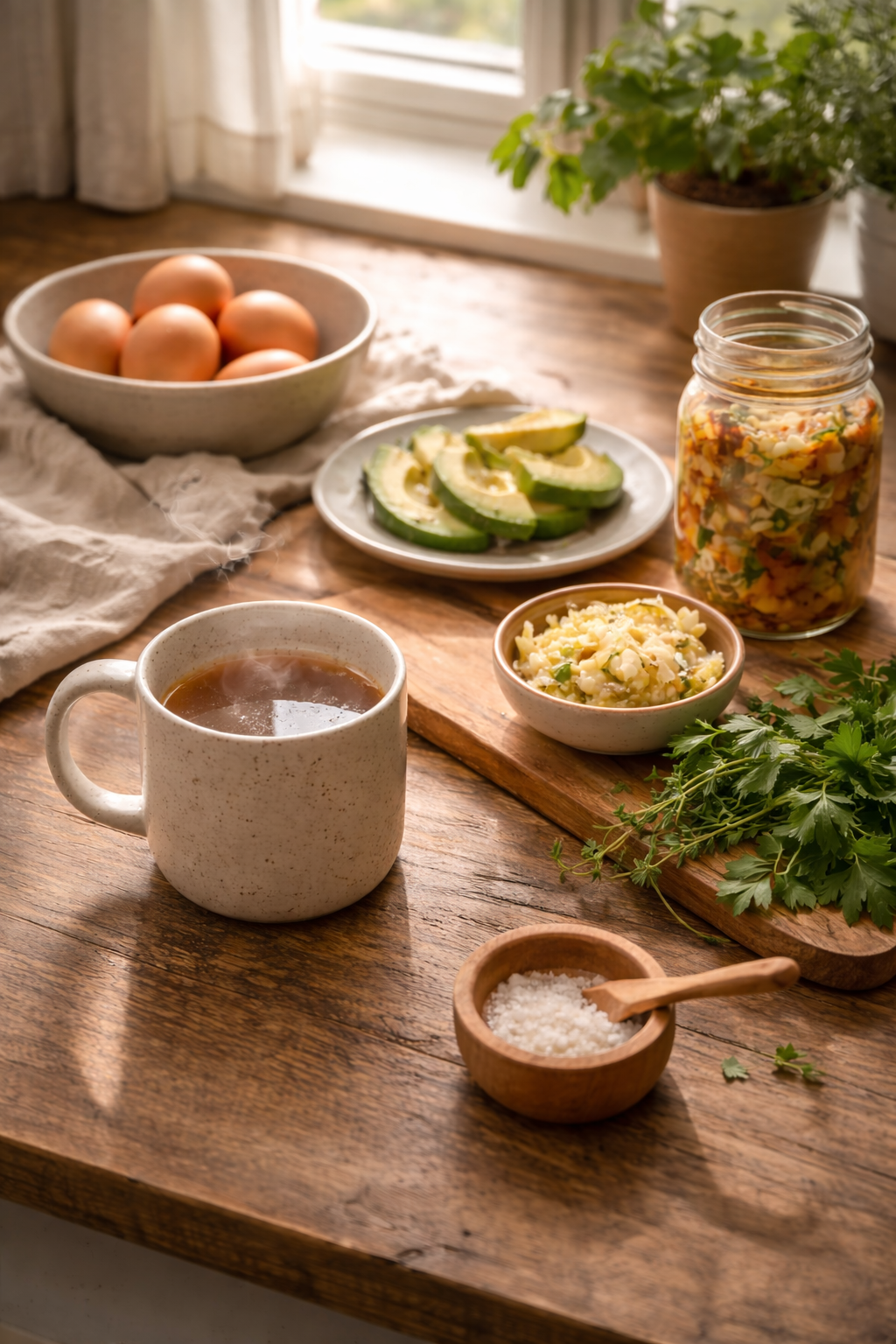
Nourish
The 21-Day Ancestral Nutrition Immersion
A simple path to more energy, calmer digestion, and balanced moods during the peri/menopause transition.
Practical meals • Daily guidance • Real nourishment
