
Why You’re Gaining Weight in Perimenopause (Even When You’re Eating Well)

Why You're Gaining Weight in Perimenopause (Even When Eating Well)
I want to start with something I hear from women often, and there's usually a lot of frustration underneath it:
"I haven't changed anything. I eat the same way I've always eaten. I'm exercising more than I used to. And I'm still gaining weight — mostly in my midsection. I don't understand what's happening."
If that sounds familiar, I want you to hear this clearly: you are not imagining it. You are not doing something wrong. And this is not a willpower problem.
What's happening is hormonal. It's metabolic. And it makes complete sense once you understand why — which, for most women, no one has ever explained.
This is that explanation.
The Weight That Arrived Without Warning
For most of your adult life, estrogen was working quietly in the background — which is why weight gain in perimenopause can feel so sudden and confusing. It supported your insulin sensitivity. It influenced where your body stored fat — directing it toward your hips and thighs, away from your midsection. It helped regulate cortisol, your primary stress hormone. And it played a significant role in maintaining your gut microbiome, which has more influence over your metabolism than most people realize.
In perimenopause, estrogen doesn't simply decline. It fluctuates — sometimes dramatically, and not in a clean downward arc, but in unpredictable peaks and drops that can continue for years. As the overall trend moves downward, several things happen at once.
Insulin sensitivity decreases. Your cells become less responsive to insulin — the hormone that moves glucose from your bloodstream into your cells for energy. When cells resist insulin, your body produces more of it to compensate. Elevated insulin is one of the most potent drivers of fat storage, and it directs that fat to the abdomen.
Fat storage shifts. Lower estrogen changes where your body prefers to store energy — from the hips and thighs to the midsection and around the organs. This is a physiological shift, not a personal failure. And it matters beyond appearance — central fat storage is tied to inflammation, cardiovascular risk, and further hormonal disruption.
Cortisol's effects intensify. Estrogen and cortisol exist in a kind of balance. As estrogen declines, cortisol's fat-storing influence becomes more pronounced. The same life stressors that felt manageable in your thirties and forties now register differently in your body — with real metabolic consequences.
Muscle becomes more vulnerable. Estrogen has a protective effect on muscle tissue. As it declines, muscle loss tends to accelerate — particularly when protein intake is low. And because muscle is metabolically active — it burns calories just by existing — less muscle means a slower metabolism.
What Your Gut Has to Do With It
Here's the piece that surprises most women, and that many doctors never mention.
There is a community of bacteria living in your gut called the estrobolome. These bacteria produce an enzyme called beta-glucuronidase, which reactivates estrogen after the liver has processed it for elimination. When the estrobolome is diverse and healthy, this process is regulated — estrogen is metabolized and cleared efficiently.
When the microbiome is disrupted — through years of antibiotic use, a diet low in fermented foods and fiber, chronic stress, or the hormonal shifts of perimenopause itself — the estrobolome can become dysregulated. This can contribute to either estrogen excess or estrogen deficiency at the cellular level, even when blood tests look "normal."
The bloating many women experience in perimenopause. The midsection weight that doesn't respond to what used to work. The mood instability. These can all trace back to an estrobolome that isn't functioning well — and the estrobolome is fed, first and foremost, by what you eat.
Supporting your gut is not a secondary concern during this transition. It is central to hormonal balance.
Why Eating Less Often Makes It Worse
When unexpected weight appears, the instinct is to eat less. I understand this — it's what most of us have been taught. And in the short term, restriction can produce results compelling enough to make it seem like the right answer.
But for women in perimenopause, significant caloric restriction tends to set off a chain of consequences that most diet advice never accounts for.
Restriction elevates cortisol. Your body experiences a significant caloric deficit as a physiological threat. The stress response activates. Cortisol rises. And as we've seen, elevated cortisol in the context of declining estrogen is a particularly potent driver of abdominal fat storage. You restrict, you lose some weight, cortisol climbs, the weight returns — often with more, and often specifically to your midsection.
Restriction accelerates muscle loss. Caloric restriction paired with low protein is a reliable formula for losing muscle alongside fat — particularly when the body is in energy-conservation mode. Less muscle means a slower metabolism. The underlying problem gets worse.
Restriction depletes the nutrients your hormones need most. The fat-soluble vitamins found mostly in animal foods are essential for hormone production, bone density, immune function, and metabolic health. These are the nutrients most commonly eliminated in low-calorie, low-fat eating. Women in perimenopause are already at higher risk of being low in these nutrients. Restriction compounds it.
The answer is not less food. It is different food. More nourishing food. Food that gives your body what it needs to move through this transition.
What Traditional Cultures Understood About Women in Midlife
I came to ancestral nutrition through a door I never expected to walk through. For years, I was vegan — not out of deep personal belief, but something that happened gradually while I was living in Mexico, surrounded by incredible tropical fruit and following plant-based teachers I really respected. I genuinely thought I was eating one of the healthiest diets out there.
My body told me otherwise, in ways I didn't recognize until much later. The deep afternoon exhaustion. The brain fog that had quietly settled in over years. The gum recession that sent me to six dentists over three years, spending nearly $1,500 in consultations, trying every remedy I could find. Not one of those dentists ever asked about what I was eating.
The shift came through a series of unexpected connections — a dear friend's husband developed a serious neurological condition, and doctors prescribed anti-anxiety medications. I had a feeling it was something else. I started digging, and realized he had nearly every symptom of severe B12 deficiency. He and my friend had been vegan for years and had never once been told to supplement. They went back to their home country, saw specialists, and after months of nutritional treatment, his symptoms reversed. He's healthy today.
That experience made me look at my own diet with fresh eyes. And right around the same time, I finally picked up a book I'd bought three years earlier and never opened: Nutrition and Physical Degeneration by Weston A. Price.
Price had traveled the world studying traditional cultures with no access to modern medicine and found remarkably good health. Different geographies, different climates, completely different foods. But one thing showed up consistently: these cultures prized animal foods and went to great lengths to get them.
I changed my diet overnight. Eggs, meat, butter, bone broth, liver. The shift was not subtle. Muscle came back. The afternoon crashes stopped. Brain fog lifted. My best friend noticed within weeks: you're moving faster. My thinking became sharp again in a way it hadn't been in years.
That's why I teach what I teach. Not from theory, but from having lived the difference.
Here's what traditional diets understood about women in midlife:
Protein from quality animal sources. Protein is one of the most important dietary levers for managing body composition changes in perimenopause. It preserves and builds muscle. It's the most filling macronutrient, naturally regulating appetite without restriction. It supports the liver's ability to metabolize estrogen.
Traditional fats, eaten without fear. The major hormones in your body — estrogen, progesterone, cortisol, DHEA, testosterone — are built from cholesterol. You cannot make adequate hormones on a low-fat diet. Traditional cultures ate animal fats and did not experience the rate of hormonal disruption we now accept as a normal part of aging.
Fermented foods regularly. These feed the gut microbiome, including the estrobolome responsible for healthy estrogen metabolism. In traditional diets, fermented foods appeared often. In most modern diets, they are an afterthought or missing entirely.
The whole animal. Organ meats, bone broth, collagen-rich cuts — these are rich in the fat-soluble vitamins and minerals that women at this stage of life tend to be low in. No supplement can replicate what they deliver.
Where to Start
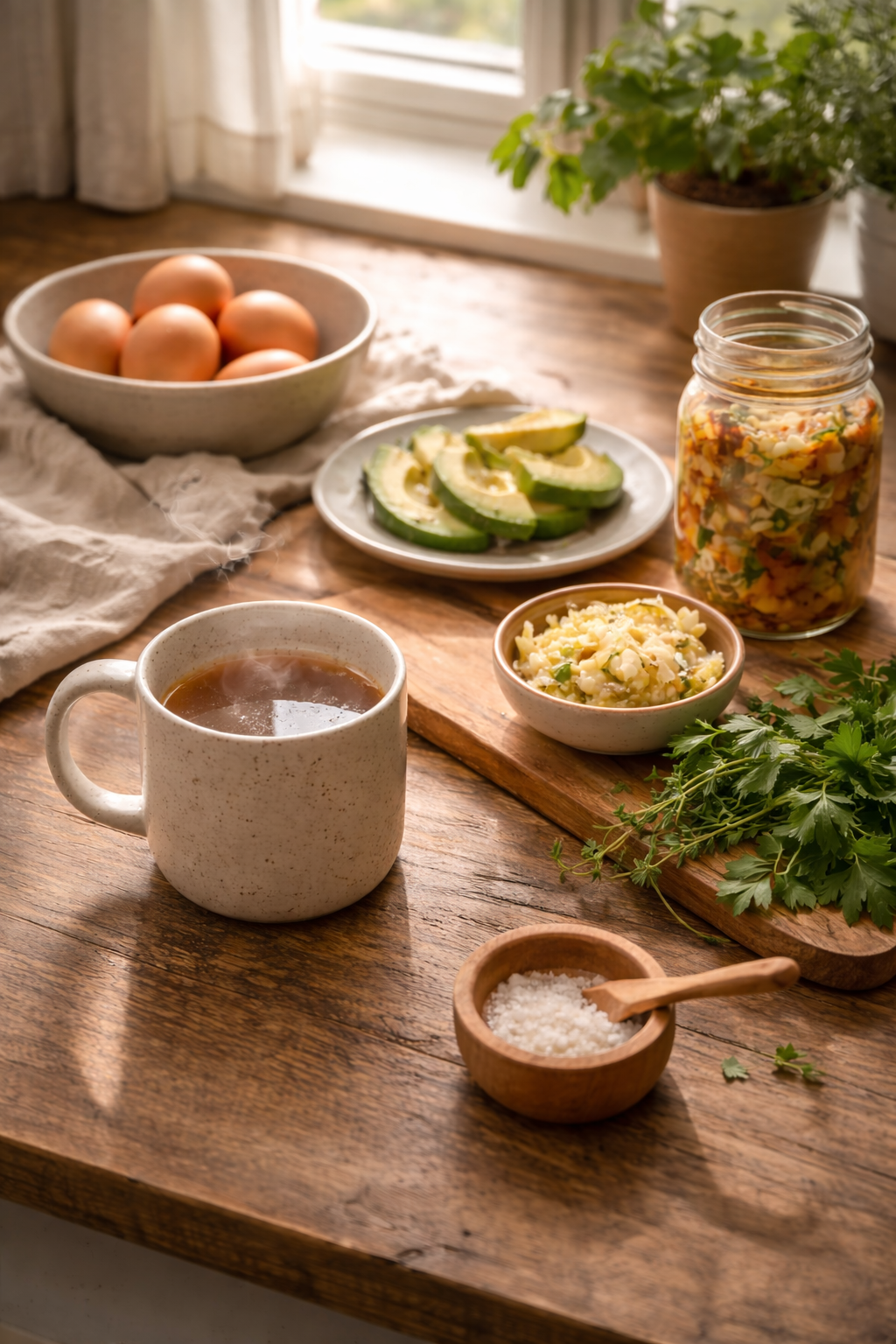
If you're ready to go deeper — to understand exactly what to eat, how much, and how to build this into your life — that's exactly what we work through inside Nourish. A 21-day ancestral nutrition immersion with a meal plan, recipes, shopping lists, and 21 days of bite-sized education you can put into action immediately. No guesswork. Just real food and real results.
Questions I Hear Often
Why is my midsection getting bigger even though I haven't changed how I eat?
Because perimenopause changed the hormonal environment that governed how your body responded to food. Lower estrogen shifts fat storage from the hips and thighs to the abdomen. Declining insulin sensitivity means glucose is managed differently. The food is the same — the body processing it is different.
Can I actually lose weight during perimenopause, or should I just accept this?
You can support healthy body composition during perimenopause — but the approach needs to change. Caloric restriction tends to make things worse by elevating cortisol and accelerating muscle loss. Increasing protein, supporting gut health, and building muscle through resistance exercise are far more effective and sustainable strategies.
What is estrogen dominance and does it cause weight gain?
Estrogen dominance refers to a relative excess of estrogen compared to progesterone, which is common in early perimenopause when progesterone often declines first. Symptoms can include midsection weight, bloating, mood changes, and heavy or irregular periods. Supporting the liver and gut microbiome — through food — helps the body metabolize and clear excess estrogen more efficiently.
Is this related to insulin resistance?
Closely related, yes. Declining estrogen is directly tied to decreased insulin sensitivity. This is one of the reasons ancestral nutrition tends to work well for women at this stage of life.
How long before I notice a difference?
Most women who apply these principles consistently notice shifts in energy, digestion, and inflammation within two to three weeks. Changes in body composition tend to follow over two to three months. It's a foundation that, once built, supports you for the years ahead.
A Note Before You Go
I spent years eating in a way I truly believed was the best thing I could do for my body — while quietly building up the deficiencies that were behind my symptoms. The gum recession. The brain fog. The afternoon crashes. The muscle that slowly disappeared. None of it had to go that way — and I know that now, which is why I teach what I teach.
The only thing that made me start looking for answers was gum recession. That sent me to six dentists over three years. But it was only after I made the connection between the gum recession, the fatigue, the brain fog, the way I was moving — and both my diet and the hormonal shifts happening in my body — that everything suddenly made sense. Not as separate, unrelated things. As one picture.
Looking back now, I understand that I was deep in perimenopause. At the time, I had no idea.
That knowledge — the kind I had to piece together myself — is what I want to give you. Not after years of searching. Now.
To your vibrant health and freedom,
Katrina
When you're ready to begin:
Nourish is my 21-day ancestral nutrition immersion, designed specifically for women in perimenopause and menopause. Over 21 days, you’ll learn the nutritional foundations that support hormone balance, gut health, metabolic function, and bone density — all through the lens of ancestral food wisdom and the science behind it.
It includes the bonus masterclass Nourish Your Hormones, a 7-part series on exactly what is happening in your body right now and what food can do about it.
Not ready yet?
Start here: Download my free guide — Why Women Over 40 Need 100g of Protein Daily — and I’ll walk you through the most important first shift in an ancestral nutrition approach. No tracking, no rules. Just real food, and the reason it matters now.
Nourish with Katrina
🎧 Podcast
Conversations on gut health, hormones, ancestral nutrition, and vibrant, holistic health for women 40+.
Available on:
Apple Podcasts | Spotify | YouTube
Nourish
The 21-Day Ancestral Nutrition Immersion
A simple path to more energy, calmer digestion, and balanced moods during the peri/menopause transition.
Practical meals • Daily guidance • Real nourishment
